6 minute read
Jump to section: acidity || tannins || sweetness || body || source material
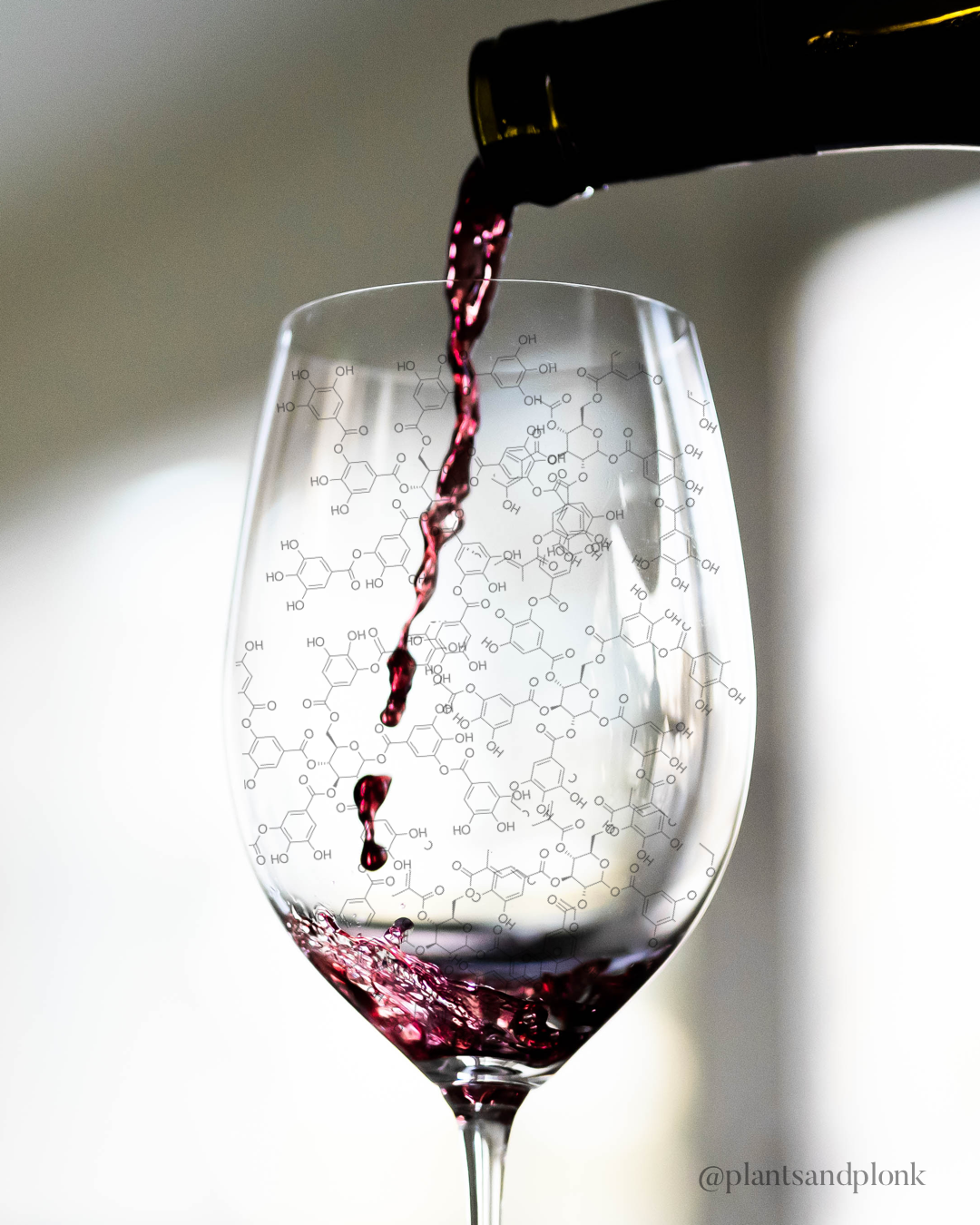
I know not everyone will join me in finding the more technical aspects of wine chemistry interesting (anyone else fangirl over Dr. Jamie Goode?), but knowing even the basics of what’s going on in your glass chemically can be super helpful for finding the right pairing.
Wine is chemically really complex – in addition to the H2O and ethanol molecules we know well, scientists estimate there could be hundreds of (or even up to a thousand) others.
Acids, ethyl esters, acetates, aldehydes, phenols, methoxypyrazines, monoterpenes, rotundone, thiols and many more. Some of them contribute individually to the flavors in wine, even though they’re present in really low amounts (I’m looking at you, methoxypyrazines), but most others interact with each other in complex ways to impact our taste receptors.
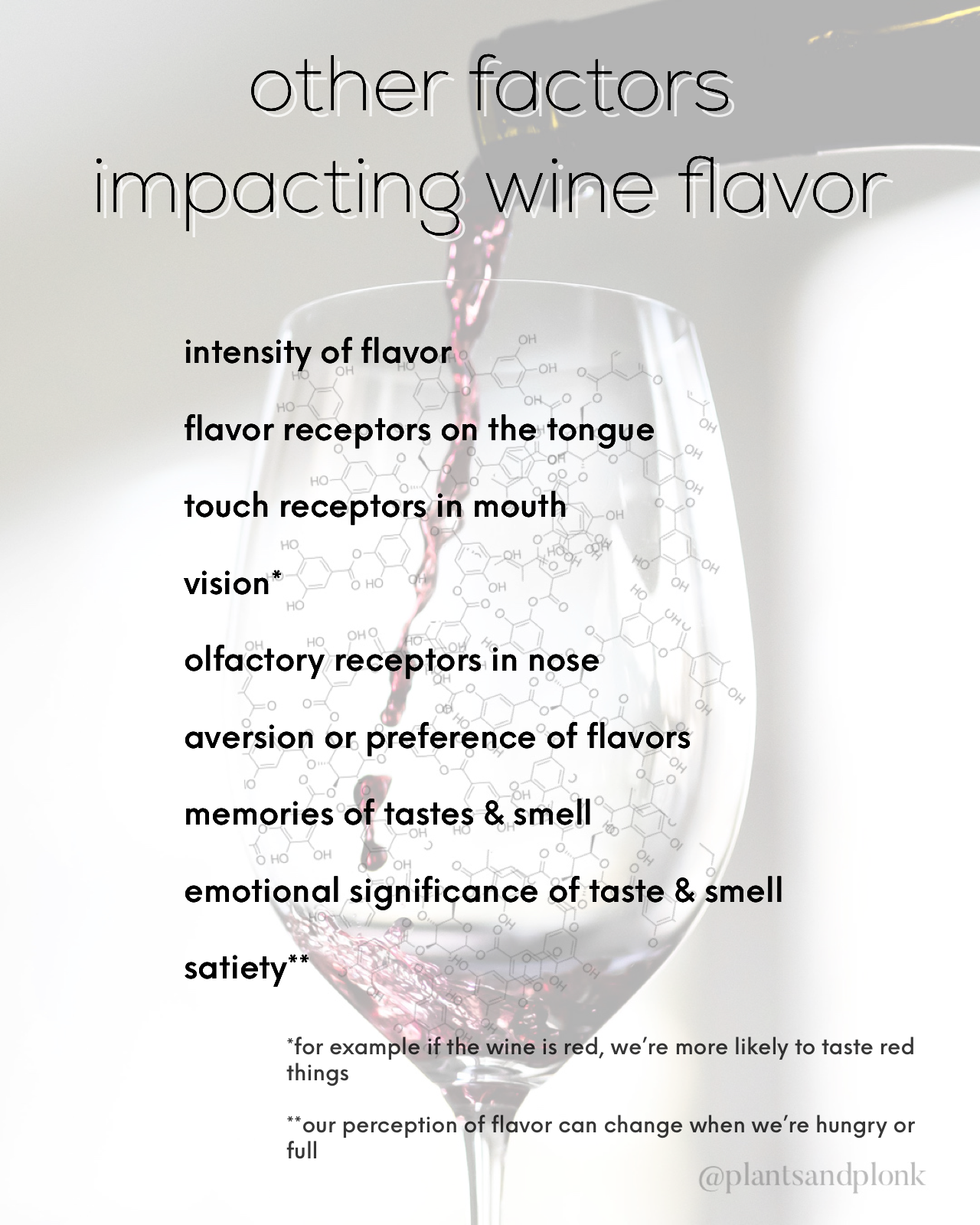
And this is just in the glass – I don’t want to downplay or dismiss the impact our individual mouths (and noses! and eyes!), memories and preferences can have on our perception of flavor. In fact, these personal aspects can significantly impact the ways our brains process what’s in our glass. Don’t believe me? Try testing your favorite wine guzzler by sneaking a few drops of red food coloring into their white wine glass. Seeing red can make us taste red things. Pretty cool, huh?
So, what are the most important tastes to consider when pairing a wine with food? Well, if we think of wine pairing as a decision tree, then the first two blocks would likely be acidity and tannins.
Jump to section: acidity || tannins || sweetness || body || source material
1st Up: Acidity & Tannins
I want to look at acidity and tannins from a slightly different angle than is usually seen in wine posts: from the perspective of the affect they have on our saliva.
It sounds kinda gross, I know. But bear with me.
Saliva plays several very important roles. Among them, protecting our mouths from potential dangers, moderating extreme flavors, and transporting taste molecules to our taste receptors.
Both acidity and tannins have a pretty substantial impact on our saliva. Let’s start with acidity.
Acidity
There are several different kinds of acid molecules in wine, but most of our perception of sourness comes from just three of them. Tartaric acid brings a sharp, stinging sourness, malic acid, a crunchy green apple sourness, and lactic acid a softer, yogurty tartness.
This overall sourness serves two purposes. First, in terms of flavor, it helps to brighten heavier, more protein rich and fattier aspects of our food (I’m gonna keep coming back to that PB&J example) and it also decreases the perception of sweetness on the palate (more on that in a bit).
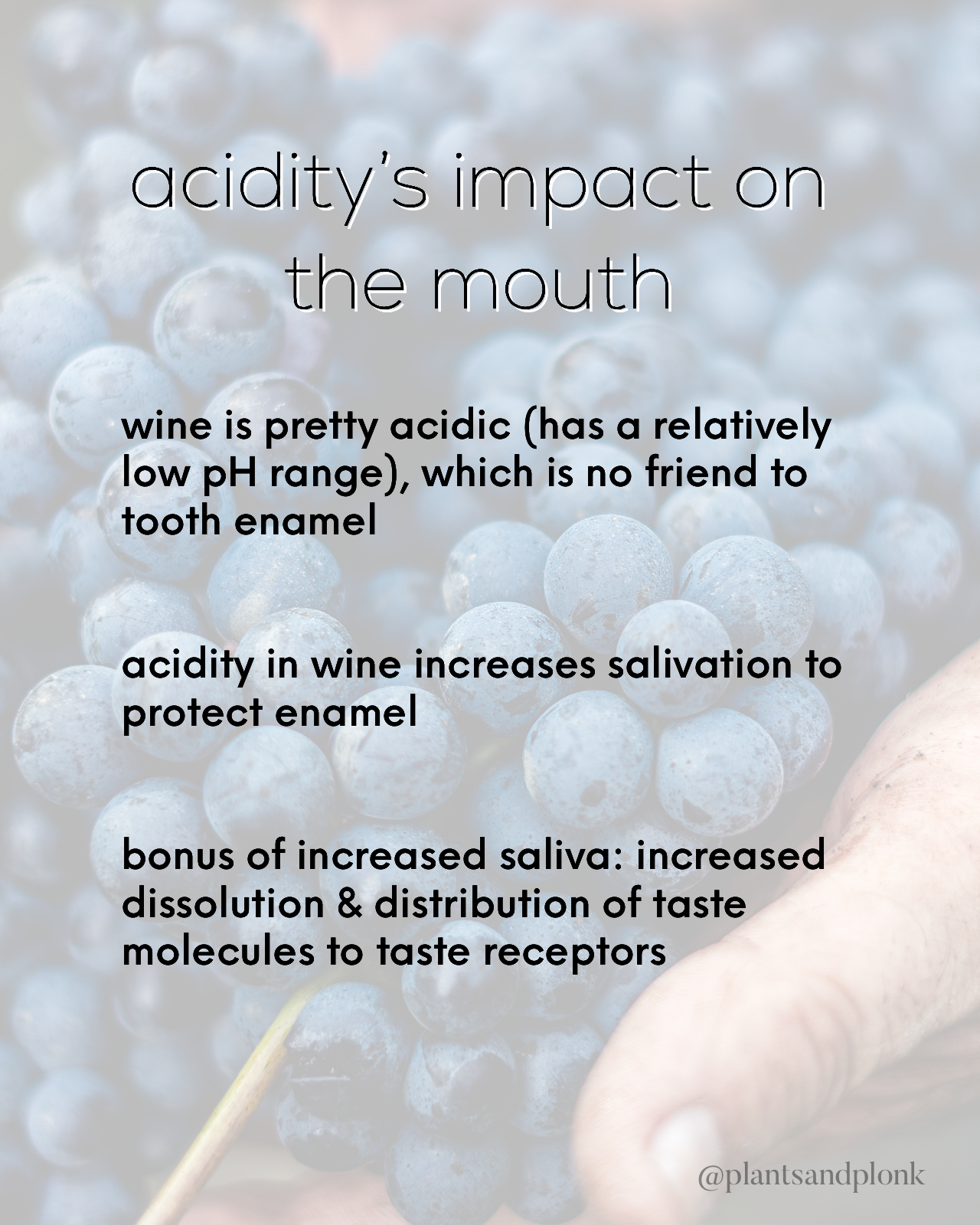
Second, acidity makes our mouths literally water (aka produce more saliva). We know some of this is a protection against the harm acidity can do to our mouths – just ask your dentist about wine drinking and your enamel. But we also know know saliva helps dissolve and distribute taste molecules throughout the mouth. So, properly balanced acidity in a pairing not only helps refresh the palate, but might actually enhance our sensitivity to taste!
Tannins
Tannins have an entirely different affect on the saliva. Tannins are more present in red wine than in white, since they come from the skins, seeds and stems of the grapes, which spent more time with red wine juice. They can be tasted as slightly bitterness, but they’re more often noticed as a feeling of drying astringency in the mouth.
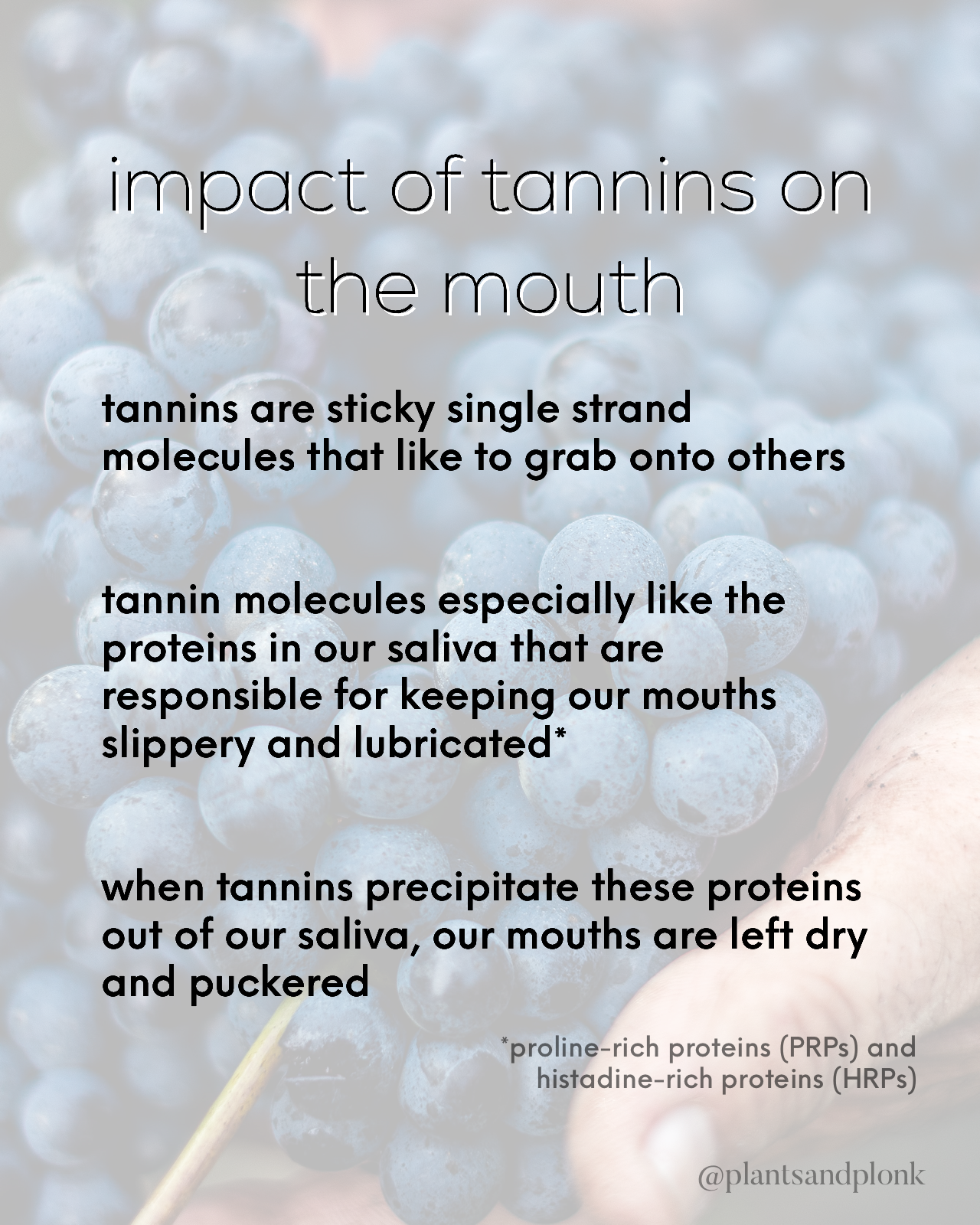
These cool little buggers come as single string molecules, but they function sort of like molecular duct tape: they’ll stick to lots of things and take it with them. They especially love to bind with the proteins in our saliva that are responsible for keeping our mouths slippery and lubricated. Once they yank those proteins out of our saliva, we’re left with a dry, puckered palate. This is why tannic wines are often best paired with fatty or protein rich dishes. We wanna distract these guys with some other molecules to grab onto and keep our slippery saliva proteins to ourselves.
Jump to section: acidity || tannins || sweetness || body || source material
Next Up: Sweetness & Body
On the decision tree of wine pairing, the next considerations are ::drumroll:: sweetness and body.
Sweetness
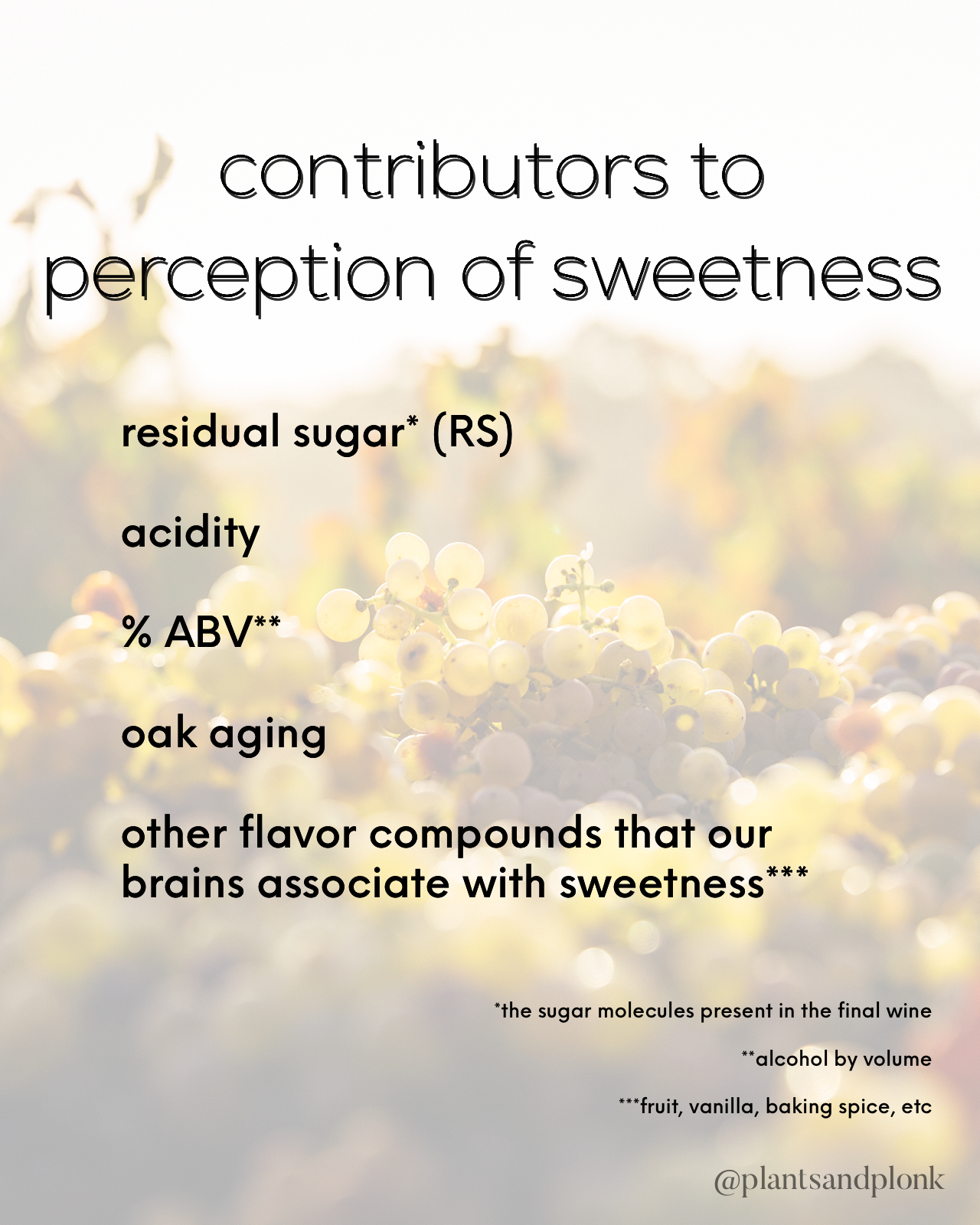
Sweetness is actually the first taste sensation our mouths register – but it’s also the first to change based on it’s environment. Our perception of sweetness depends on several factors: the wine’s acidity, how alcoholic it is (ethanol also contributes sweetness), whether it’s been aged in oak (again, more minute sweet molecules) and the molecular compounds our brains think of as sweet, like fruity or vanilla flavors.
Most of the table wines on the market are pretty dry – they contain very low amounts of residual sugar (RS). But, because our perception of sweetness depends on so many other factors, our brains often don’t differentiate the exact molecular stimuli.Interestingly, the more natural acidity a wine has, the more our palates want for a bit of sweetness. Think about biting on a lemon slice – who can stand that without a sprinkle of sugar?
So, sweetness in pairing is quite a delicate balance. We want to consider all of these factors – perceived or otherwise – to find synergy between the wine and food we’re pairing.
Incidentally, the amount of sugar in a wine also contributes to the wine’s body (think about how heavy syrup can be).

Body
The rest of a wine’s weight and mouthfeel (or our perception of it) is a complex combination of the tannins, the glycerol and compounds called mannoproteins, in the wine. Mannoproteins come from the cell walls of the yeast used to ferment wine. So the body of the final wine will also depend on which type of yeast was used to ferment it and whether it spent time on the lees (dead yeast cells).
For a long time, we thought that alcohol content had a big influence on the body of a wine, but these days it’s less certain. I found several sources saying it did influence body and others saying it had no impact, so it looks like the jury is still out on this.
Regardless – knowing the body of a wine will help us pair with the weight of the dish – is it heavy or light? Are the flavors intense or subtle?
There are of course many other factors that contribute to a wine’s taste or its influence on the palate, but these four – acids, tannins, sweetness and body – are really the four first ones to consider if our goal is to find a good pairing. Two wines can both have cherry flavors, but if one of them has high acidity, high tannins, no RS and a full body and the other has low acidity, medium tannins, significant RS and a medium body, they’ll interact with the food very differently.
At the end of the day, though, don’t forget: if you like it, it doesn’t matter. Drink what you like with whatever you want to eat. Just do it responsibly!
Jump to section: acidity || tannins || sweetness || body || source material
Sources for this Post:
Books:
Wine Science: The Application of Science in Winemaking by Jamie Goode, PhD
Wine Science: Principles and Applications by Ronald S. Jackson, PhD
Food and Wine Pairing: a Sensory Experience by Robert J. Harrington
What to Drink with What you Eat by Andrew Dornenburg and Karen Page
Articles:
Wine Anorak post: Tannins in Wine
SevenFifty Daily: The Science of Tannins in Wine
SevenFifty Daily: Understanding the Role of Sugar in Wine
GuildSomm articles by Jamie Goode, PhD:
- Wine Flavor Chemistry
- The Taste of Wine: Acid, Sweetness, and Tannin
- Questions on Chemistry and the Flavor of Wine
“Oral Wine Texture Perception and it’s Correlation with Instrumental Texture Features of Wine-Saliva Mixtures” by Laura Laguna, María Dolores Álvarez, Elena Simone, Maria Victoria Moreno-Arribas and Begoña Bartolomé

 celeste radosevich
I know! Crazy huh? Definitely a true combination of art and science.
LikeLike
Very interesting Celeste. What a complex process it is to produce and appreciate wines!
LikeLiked by 1 person
Coming from someone with much more of a science background than me, that’s a huge compliment! Thanks!
LikeLike
Brilliant! Very informative and thoughtfully written.
LikeLiked by 1 person