7 minute read
Jump to section: about the wine || about the pairing || recipes
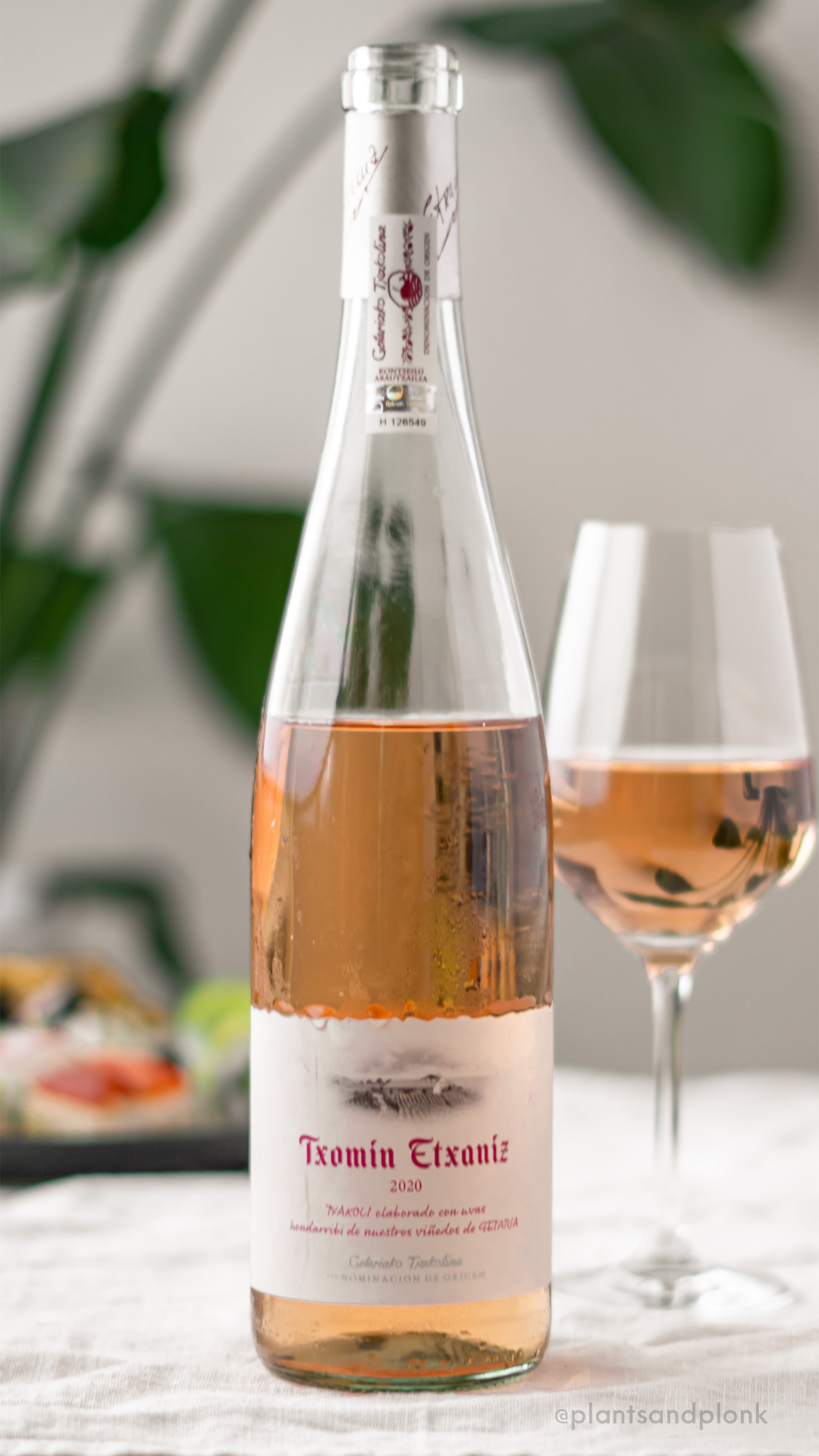
I know we just rang in fall with a warming red, but I couldn’t pass up this little known pink gem from Spain – especially after reading my friend Ellen Bhang‘s encouraging Boston Globe article on fall-friendly Basque beverages.
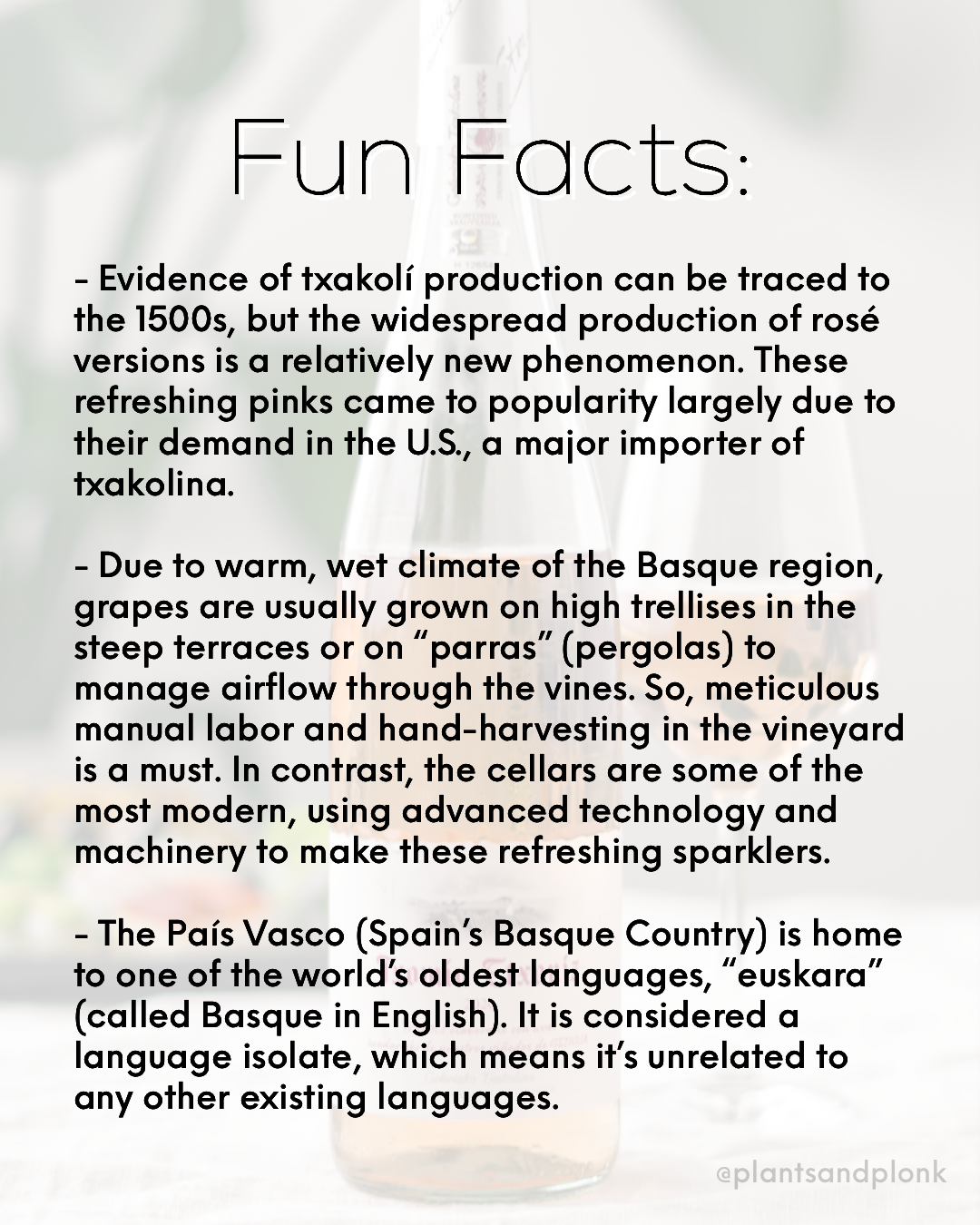
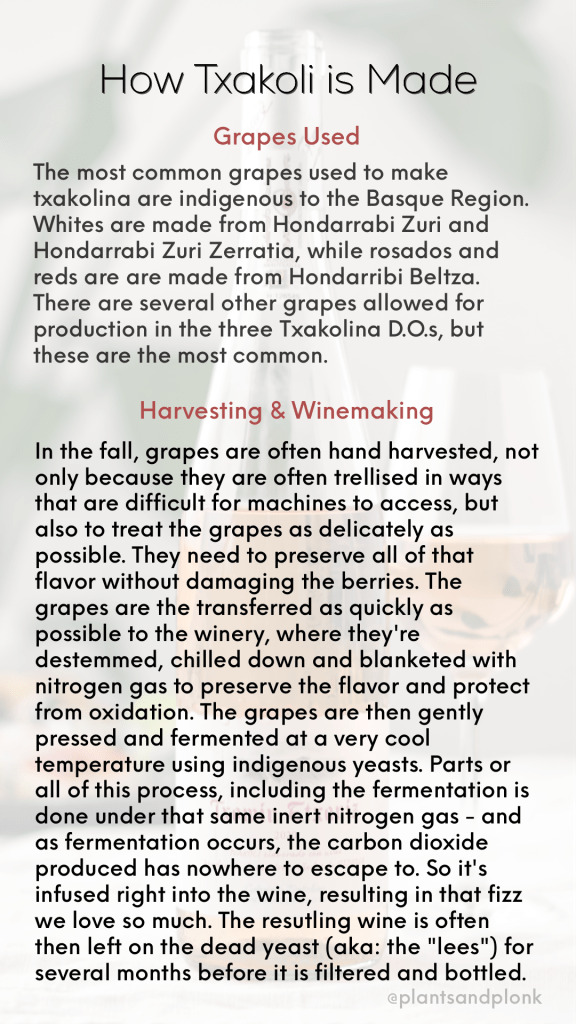
Most of the wine produced in the Spanish Basque region is white, but this wine is a rosado (the Spanish word for “rosé”). It’s called Txakoli (pronounced cha-ko-LEE) and is also referred to as Txakolina (in the local language, the latter translates to “the Txakoli”). Whether white or rosado (or even sometimes even red!), these wines are refreshing, light, and slightly effervescent. (You can see more about how the grapes used to make these wines in the note below.)
They have been on shelves and in restaurants in the U.S. for a couple of decades. It seems strange that I’ve see them a bit less during my time here in Europe. Could it be because U.S. has been gobbling up most of the production since the 2000s? ::cue me stroking a fake beard::
Indeed, the States now constitute the leading export market for Txakolina. And the Basques themselves consume quite a bit of their own wine. Sadly, that doesn’t leave much for the rest of us in Europe. Womp.
Jump to section: about the wine || about the pairing || recipes
About Txomin Etxaniz
Fortunately, the makers of this bottle, Txomin Extaniz, are the largest winery in the small region of Getaria, so their wines aren’t too hard to find. They’re also the oldest winery in that region and have been producing wine for centuries. In fact, the Txueka family that owns the winery is proud to hold a document from 1649 attesting to their ancestor’s use of the vineyard as collateral for a bank loan.
Since then, they not only survived a gruesome civil war, two world wars and the oppressive Franco regime (which was particularly brutal for this autonomous cultural region), but they also played a crucial leading role in establishing their regional wine designation of origin (better known as D.O.). Both Txomin Extaniz and the Getariako Txakolina D.O. are now thriving, with the winery producing about 18% of the region’s output.
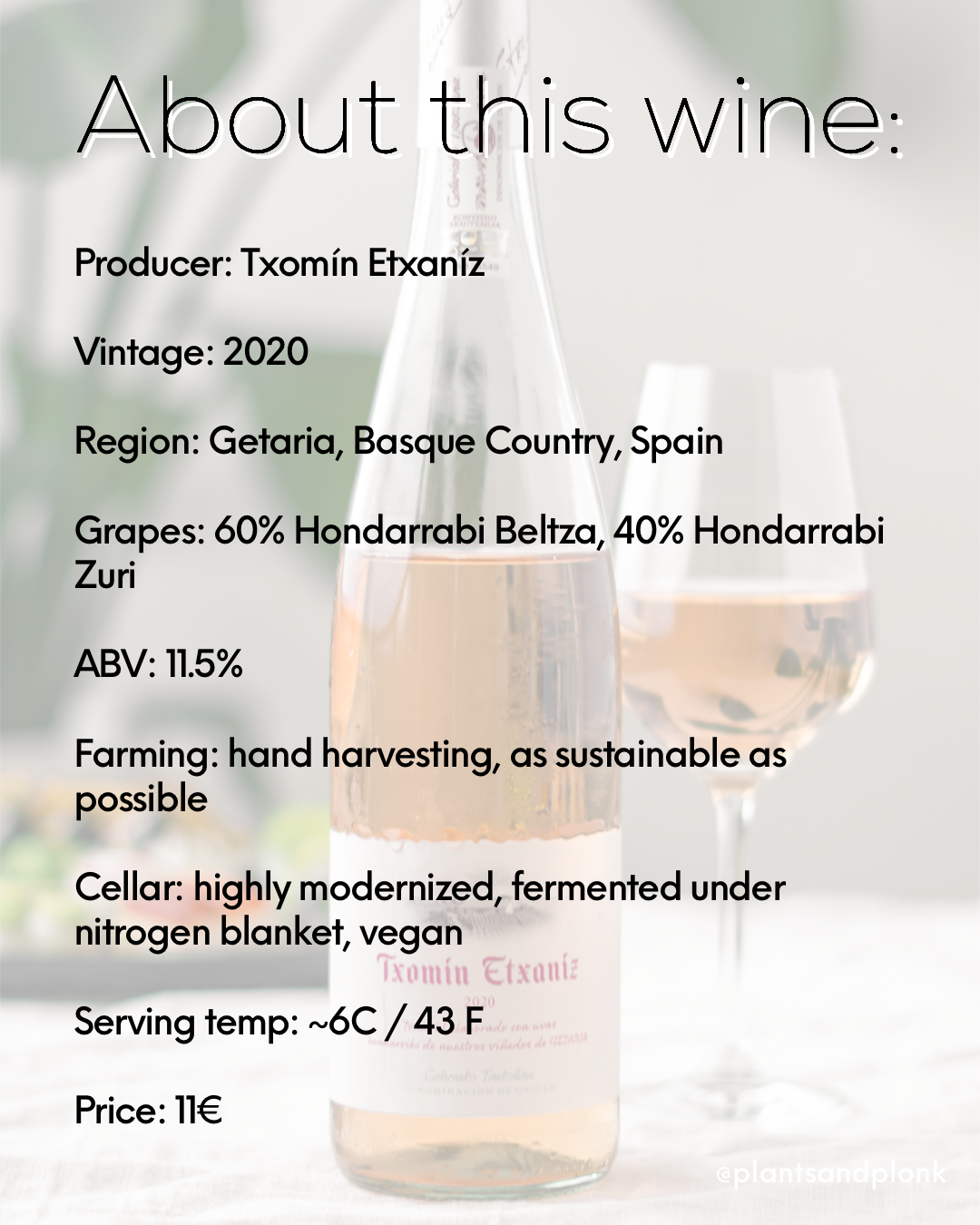
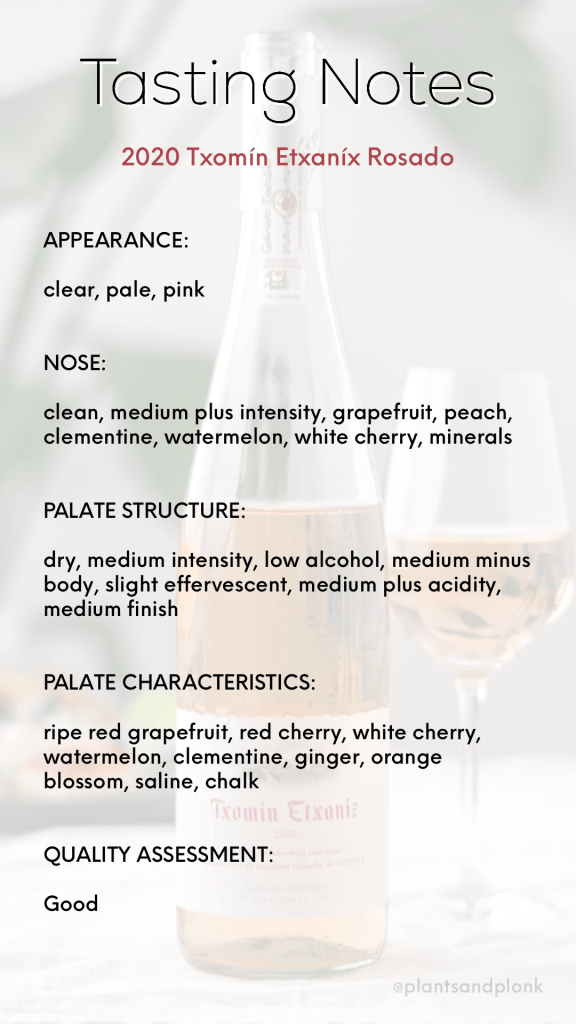
2020 Txomin Extaniz Txakoli Rosado
This week’s post is all the better for that substantial production. This bottle is a true delight with its fresh red and white fruit and zesty acidity (see my full tasting notes below). It has a very light spritz to it from the CO2 that naturally infuses into the wine during fermentation. (Learn more about how this sparkler is made in the notes below.) This wine is so easy to drink, I had to be very disciplined to save enough for the pairing. But at about 11 Euros a pop, I’m wishing I’d just gotten two!
Jump to section: about the wine || about the pairing || recipes
Pairing with txakoli rosado
This wine could be easily enjoyed on its own, but I dreaded justifying to my husband why I’d polished off this bottle without sharing any (or making dinner to accompany it). Besides, the Basques are well known for pairing their wine with a wide-ranging cuisine. Not only does the region boast a staggering 40-some-odd Michelin starred restaurants, but several of these chefs wowed the world at the 30th anniversary of the first Basque D.O. in 2019: they came together to create a 6-course menu paired entirely with different bottles of Txakoli.
On another note, the geographic location of el País Vasco (Spain’s Basque country) has had a significant impact on how Txakoli is paired with foods. The region is situated right on the Bay of Biscay. So, historically, this beverage has been extensively paired with fare from the sea (although unfortunately very not plant-based). And it made me want to try my hand at it.
When I went fishing for that wonderful sea flavor (see what I did there?), I found it in the form of plant-based sushi. Sushi, being from a very different sea-adjacent country, is usually thought of as a seafood- or fish-based cuisine, but it is actually a form of preparation. And, incidentally, it’s incredibly varied.
Beyond the precedence set by the region’s location and cuisine, I also did my due diligence in regards to assessing the wine’s characteristics. This is a wine with no perceptible residual sugar or tannins, with low alcohol, elevated acidity, and moderate intensity of fresh fruit flavors. Plus it has that slight effervescence to it. Putting all of this together, I knew I was aiming for lighter fair and fresh flavors. At the same time, I knew I could pump up the richness of the food if I wanted to, since the acidity is a bit higher and bubbles are natural palate cleansers.
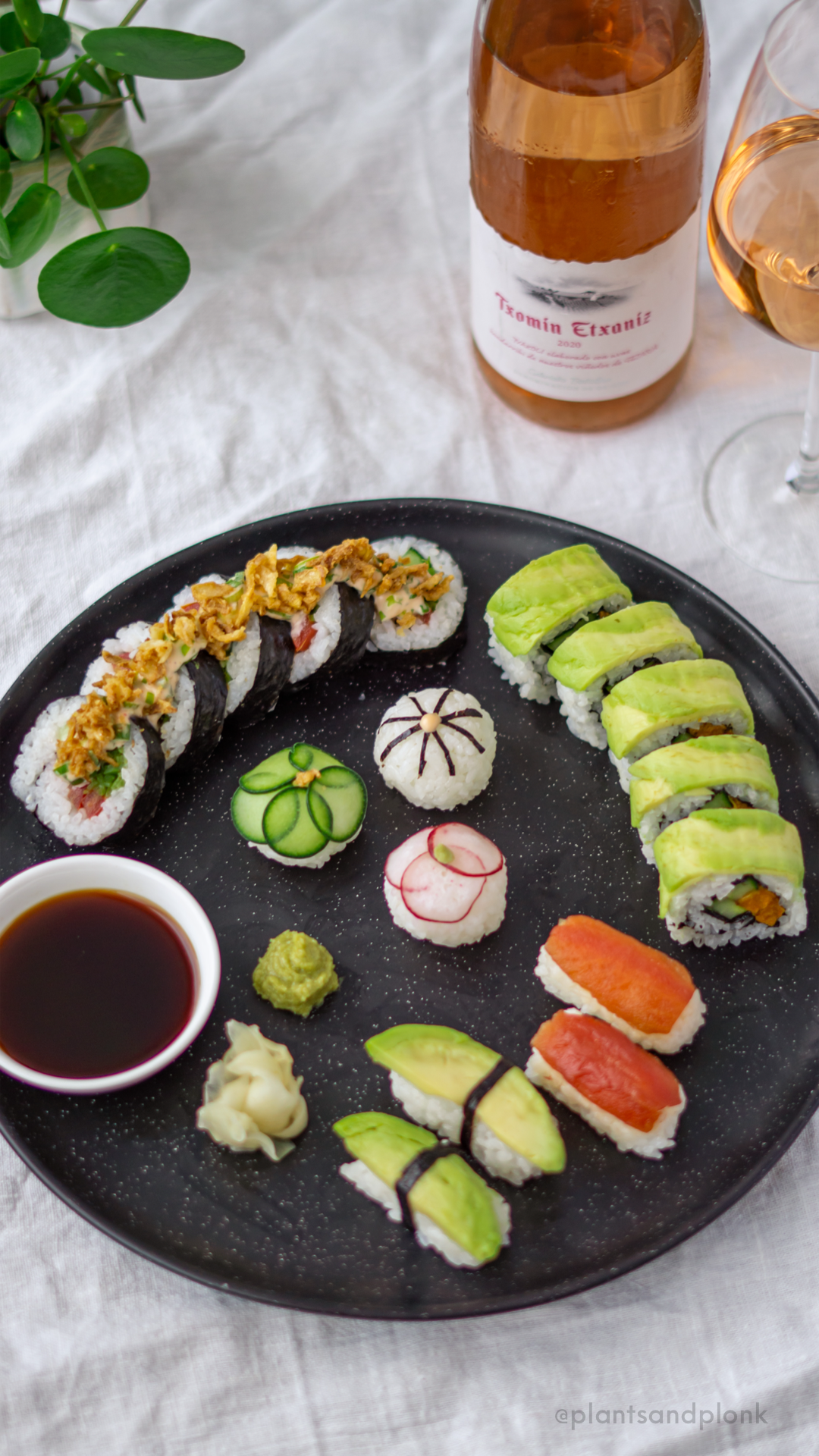
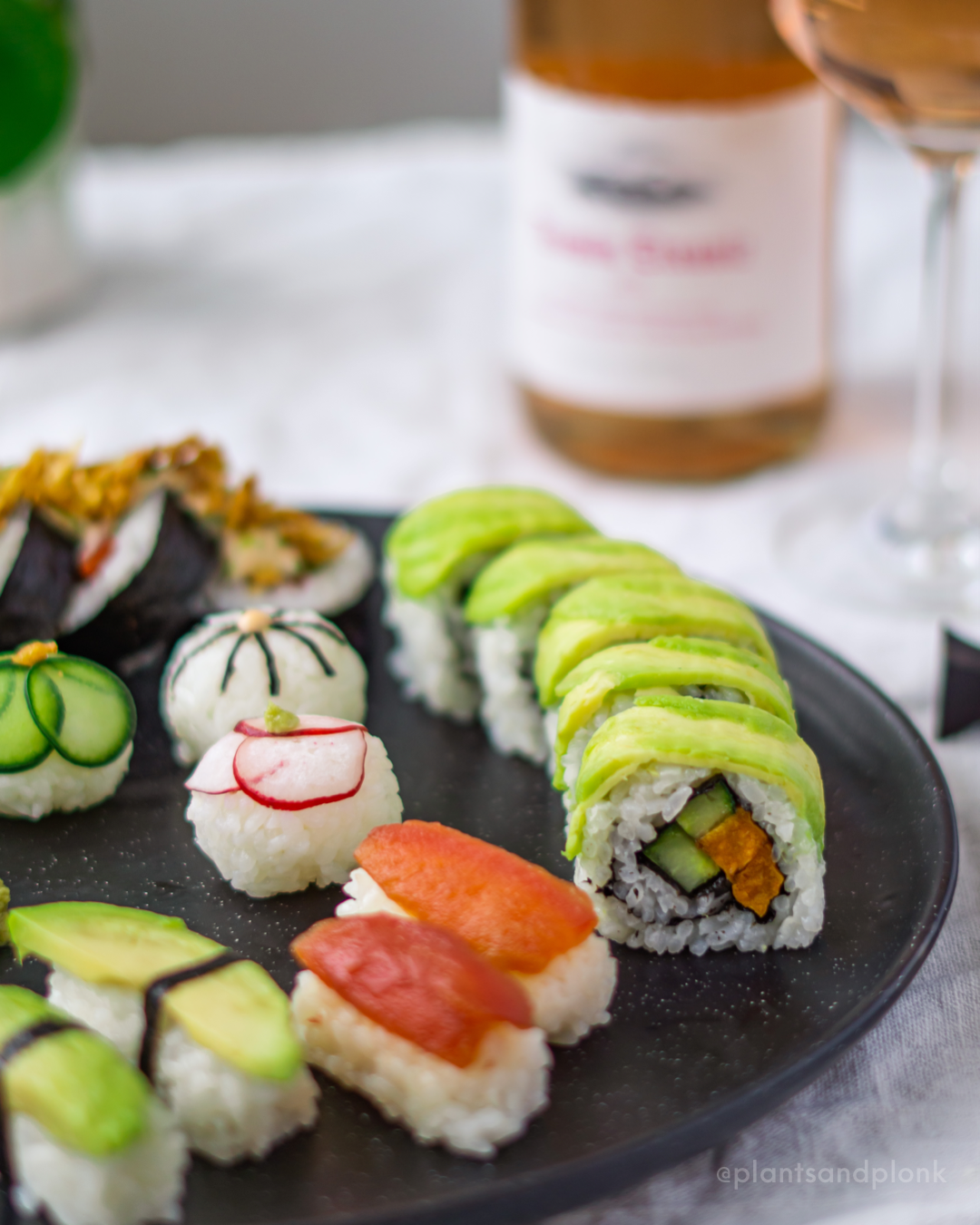
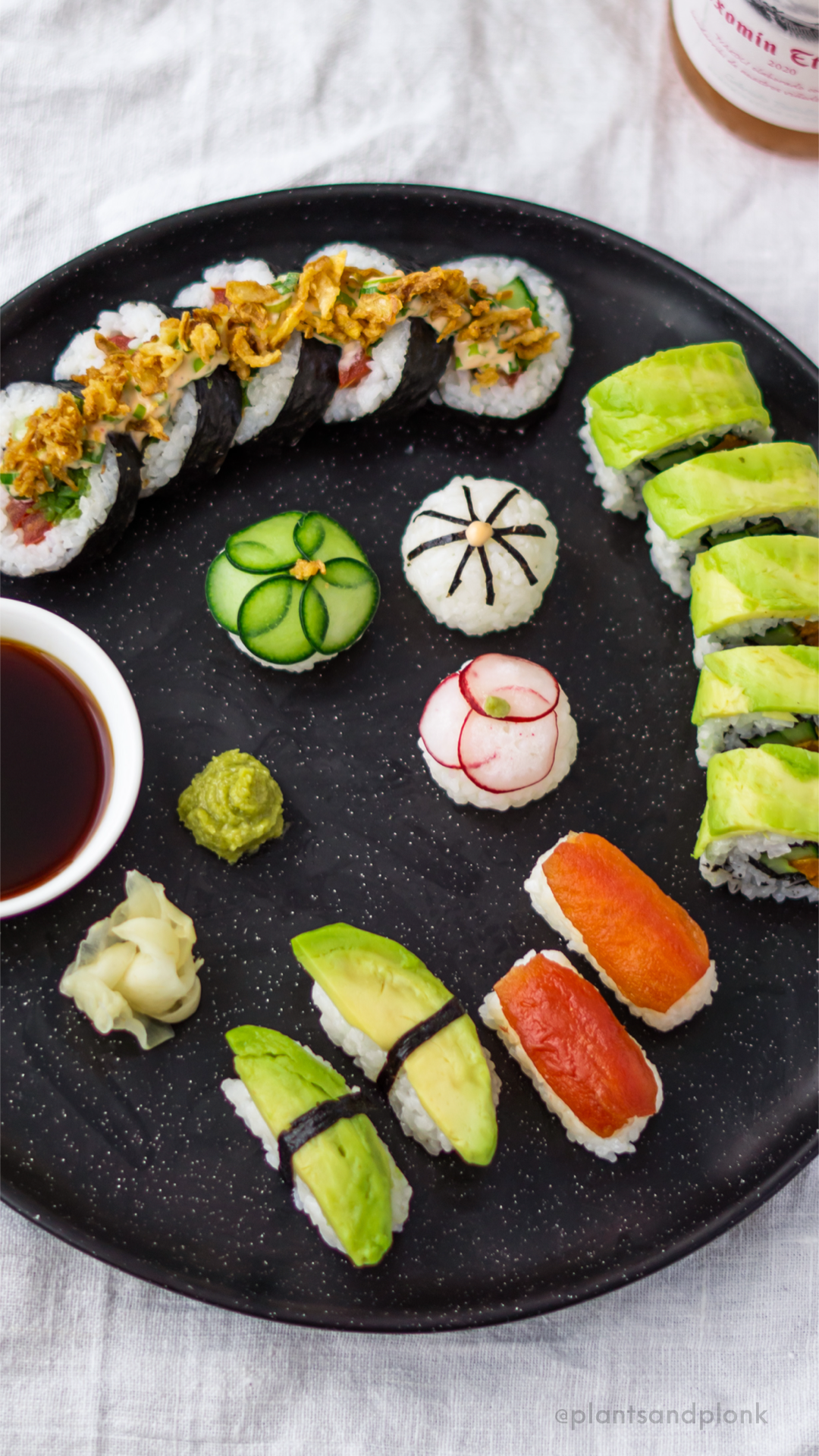
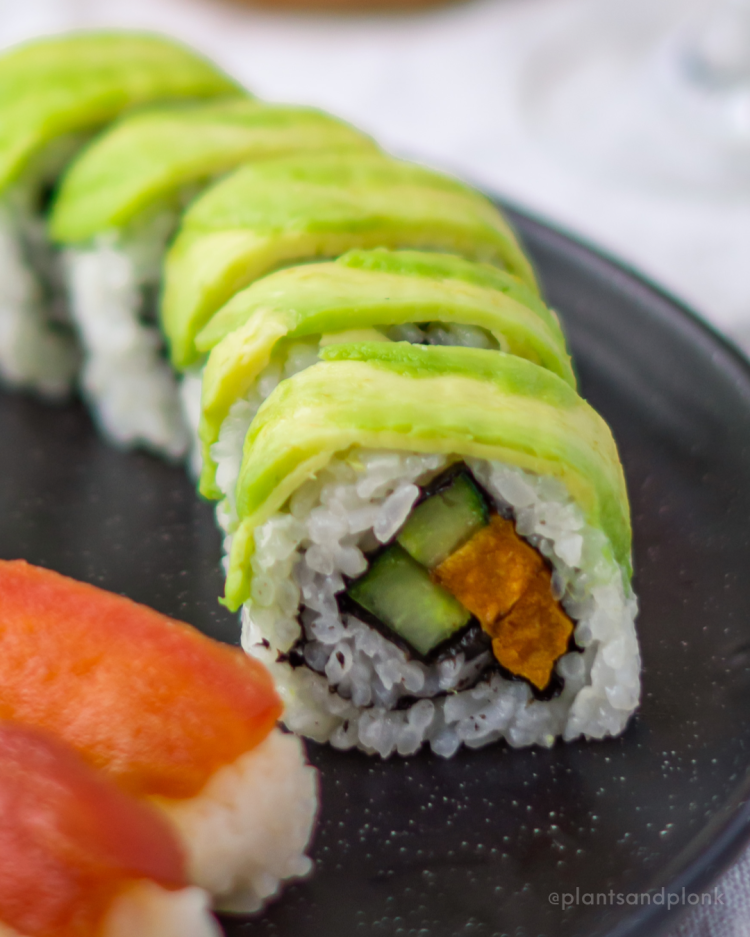
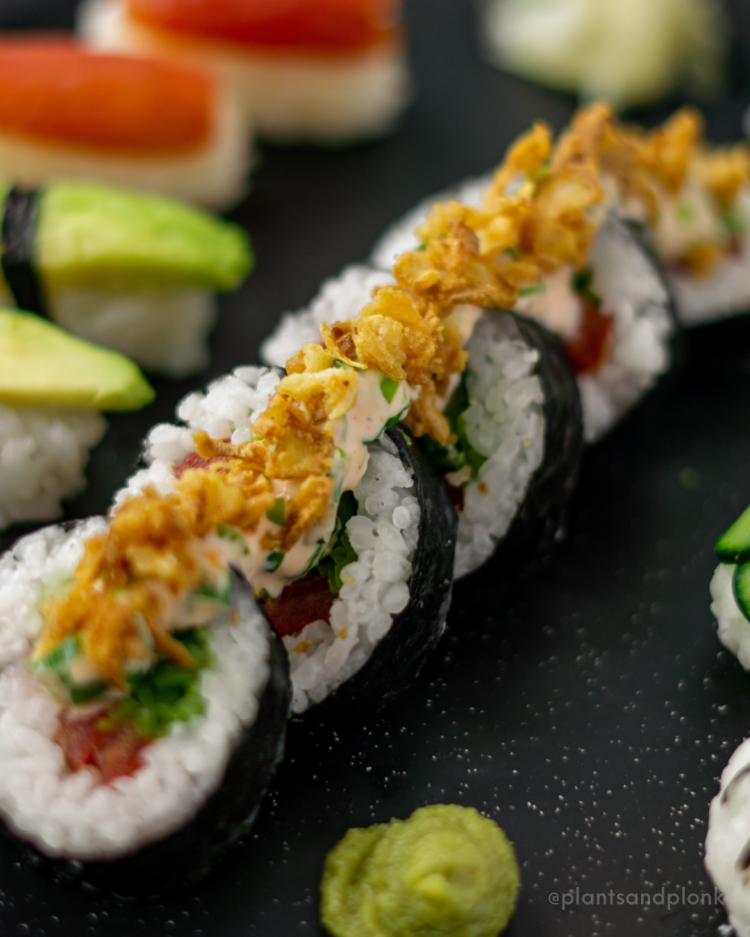
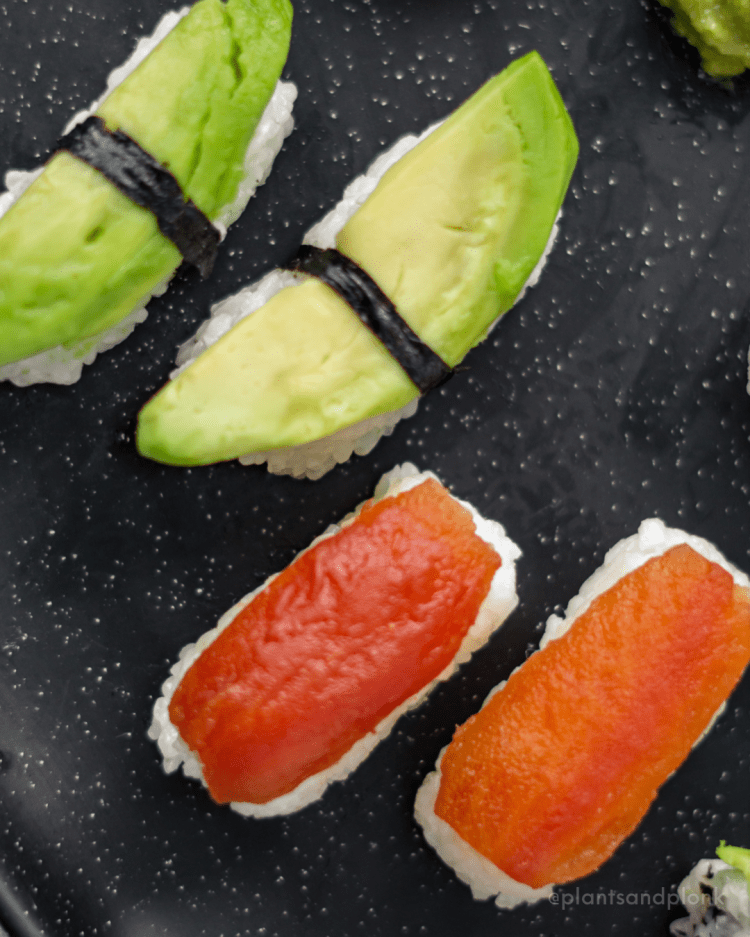
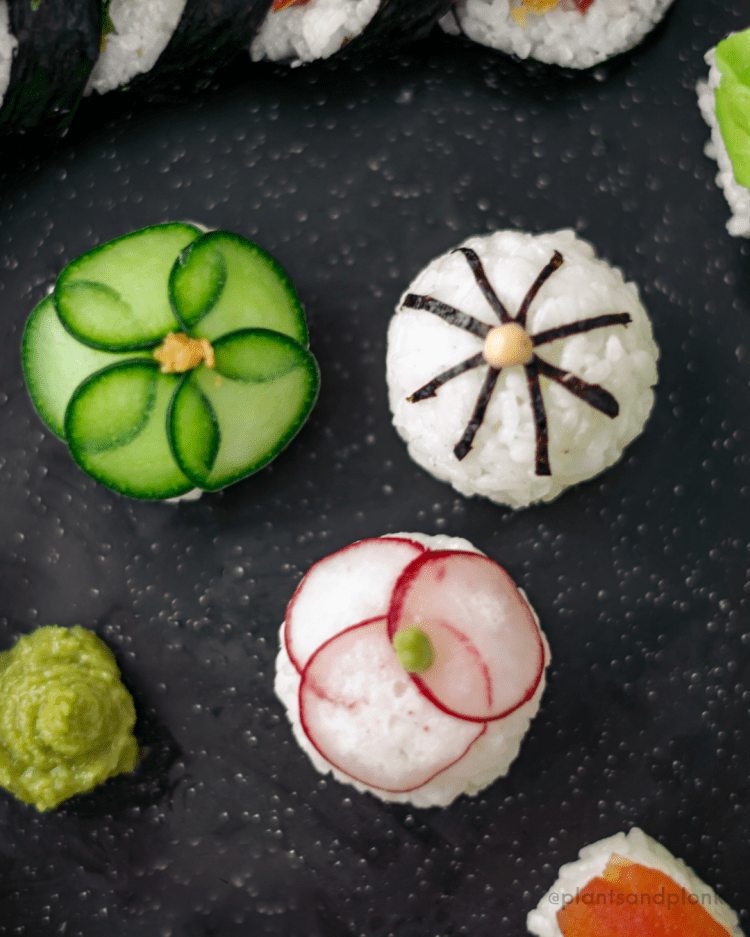
I ended up really testing Txakoli’s flexibility with this plate – avocado and “tuna” nigiri, a crunchy, spicy tomato maki, cucumber and radish temari (small rice balls topped with razor thin ingredients) and a sweet potato and cucumber inside-out maki topped with avocado.
Jump to section: about the wine || about the pairing || recipes
How did it go?
The fresh fruit of the wine complimented and enhanced the sweet potato maki while also contrasting and balancing the sharpness of the radish temari. Txakolina’s bright acidity cut through the creamy spicy mayo of the crunchy tomato maki, but wasn’t too much for the intense umami of the marinated “tuna” nigiri. The cooling watermelon flavors in the wine worked as joint palate cleansers along with the cucumber temari. And the wine’s light spritz was enough to keep the mouth from being overwhelmed by the creamy fattiness of the avocado nigiri.
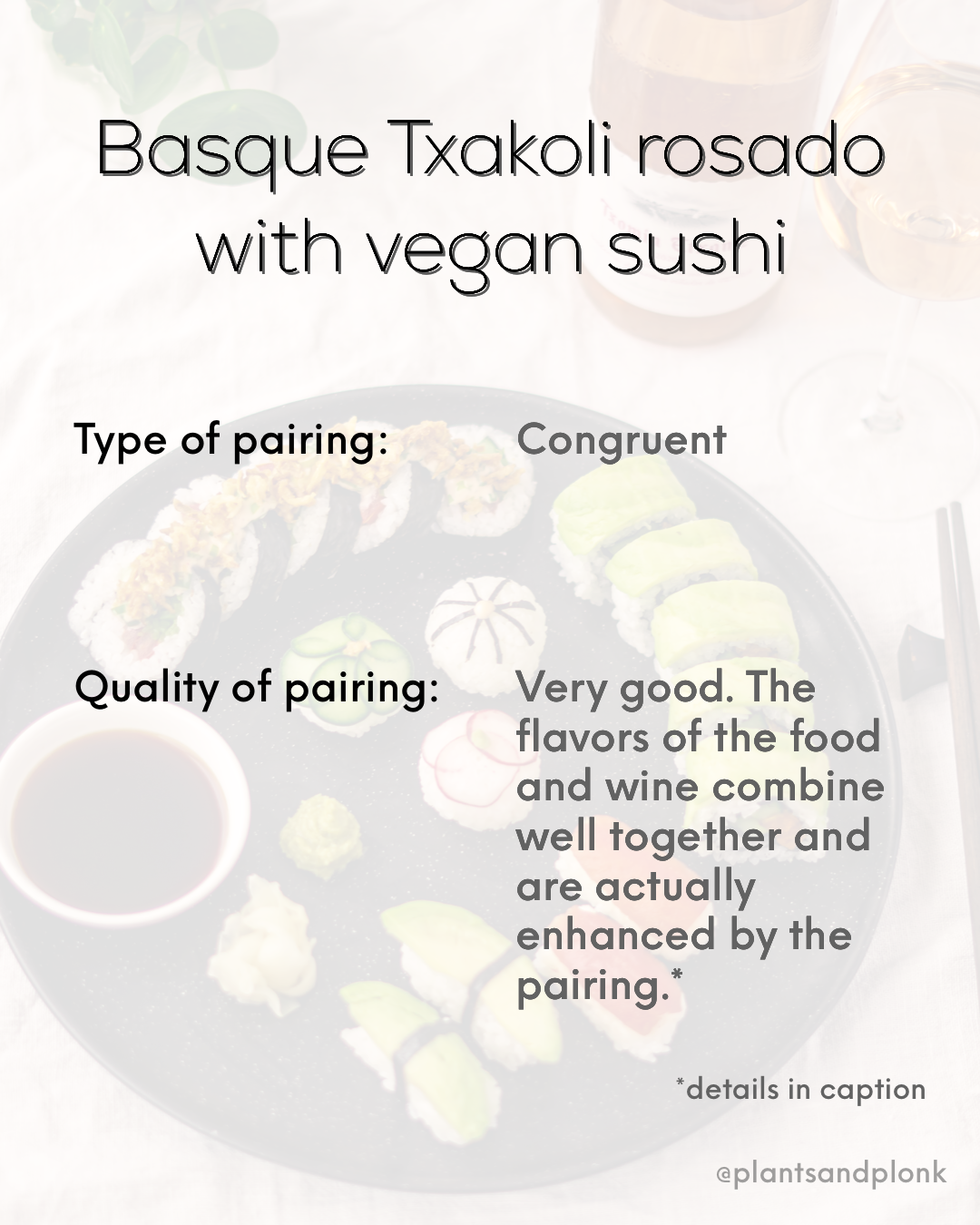
This Txakoli definitely delivered! (In that “I’m-a-huge-overachiever” kind of way.) I’m calling this a congruent pairing because both the food and the wine share a similar intensity and delicacy, but in many ways the pairing is also complimentary. Now I get why this wine and others of its region are so celebrated for their diversity. What a home run!
About vegan sushi
I don’t remember when exactly I finally gave up seafood sushi on my plant-based journey, but it’s safe to say it was one of the last things I let go of.
I know we’ve established that sushi isn’t exclusively about fish and seafood, but the overwhelming majority of available options are. Especially in the U.S., where I first tried and fell in love with the cuisine.
Fish is really hard to veganize. There are very convincing plant-based options for dairy, beef, pork and even chicken, but the umami and saline flavors that come from fish are particular, distinct, and hard to replicate.
Hard…but not impossible ::wink::
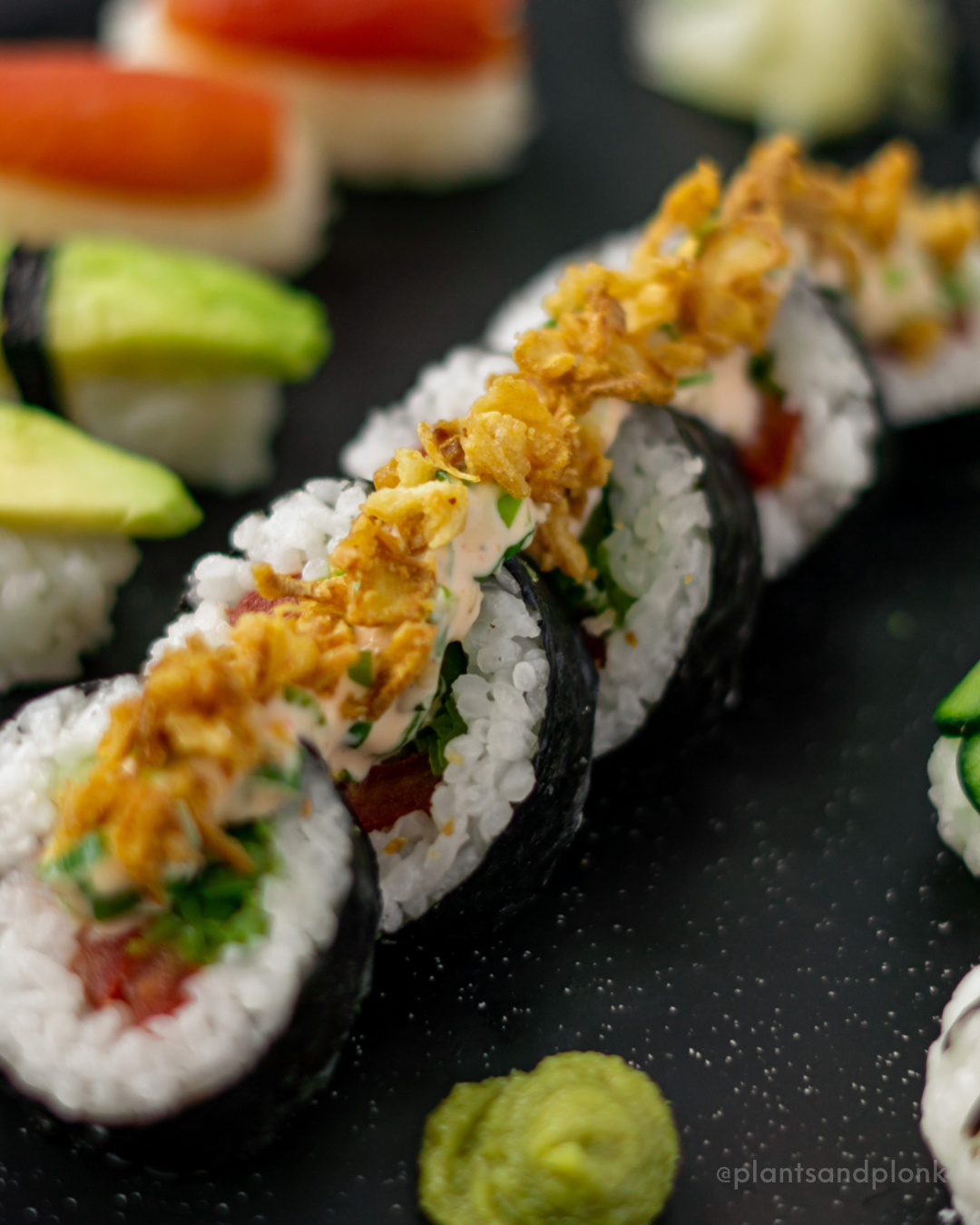
That’s not to say the unadulterated plant-based options aren’t delicious. Both my husband’s favorite and my own is the crunchy, spicy tomato maki. And the inside-out roll has a delightful internal contrast with its roasted sweet-potato intensity and its cucumber coolness. To both of our surprise, all of the temari were actually really enjoyable. Like popcorn sushi! (Please don’t hate me, Japan.)
But, it’s nice to have options. And I really wanted to make some fishy nigiri (pun intended).
So I went about researching an imitation tuna nigiri recipe. There are loads of great recipes out there, but I found the basis for mine on Jun Goto’s YouTube channel. He makes a spicy “tuna” roll in this video, so in addition to tweaking the marinade, I also had to adapt the method a bit. But he’s great, definitely check his stuff out.
I also want to note that making and seasoning the rice for sushi is arguably the most important part. The recipe I use is from a sushi cookbook I bought ages ago by Kimiko Barber and Hiroki Takemura. It’s called Sushi Taste and Technique (the idea for the tomato and sugar snap pea roll also came from that book). I won’t reproduce that recipe here, but there are many online recipes, tutorials and instructional videos, so I’m confident you’ll find some good information easily.
In any case, it’s worth taking the time and energy to make sure this part is right. Once you have it down, a simple avocado and cucumber hand roll will be lightning years better than any fancy sushi-to-go box you’ll try.
A final note on method: rolling maki can be a bit challenging at the beginning, especially to keep the roll restaurant-tight. A bamboo roller can help with this, but to be honest, a lot of it is practice. So be patient and don’t give up! I give general instructions below, but, it might be worth a quick Google search for “how to roll sushi maki.”
Jump to section: about the wine || about the pairing || recipes
Tasting and Other Notes

Recipes
Ingredients
For 1 sweet potato inside-out maki (See instructions below)
- 1 cup prepared sushi rice
- 1 nori sheet
- 1 sweet potato cut into ¼ inch matchsticks and roasted
- ½ cucumber, cored and cut into ¼ inch matchsticks
- .75 very ripe avocado, sliced paper-thin (use the remainder for nigiri)
For 1 crunchy, spicy tomato maki (See instructions below)
- 1 cup prepared sushi rice
- 1 nori sheet
- 10-12 sugar snap peas, lightly steamed & julienned
- 1 tomato, seeded and flesh julienned
- ¼ cup vegan mayonnaise (we prefer Follow Your Heart, but we also used Helmann’s)
- 1-2 tbsp sriracha
- 1 tsp sesame oil
- 1 tbsp sesame seeds
- 2 green onions, finely diced
- fried onions to garnish
For the “tuna” and avocado nigiri (See instructions below)
- .25 cup prepared sushi rice
- ¼ very ripe avocado
- 2 tomatoes
- 2 tbs soy sauce
- 1 tbs sesame oil
- 1 tbs Mirin
- 1 tsp rice vinegar
- ½ tsp dried mushroom powder
- 2 tsp nutritional yeast
- ½ nori sheet, torn in small pieces
- ½ pack seaweed snacks, torn in small pieces
- 1 postcard sized kombu, cut in half
For the veggie temari (See instructions below)
- .25 cup prepared sushi rice
- 1 radish, sliced paper thin
- 1 baby cucumber sliced paper thin (or use the ends of an English cucumber
- ¼ sheet of nori cut in very thin strips (about 3mm wide by 2 in long)
For serving
- pickled ginger
- wasabi
- tamari (gluten free soy sauce)
Helpful tools:
- bamboo sushi mat
- plastic wrap
Directions for the rolls:
Inside out sweet potato roll
Have all ingredients ready and within reach
Wrap a bamboo sushi mat with cling wrap and place a piece of nori on top, rough side up.
Place the sushi rice on the nori and spread evenly with fingers (I make sure to have a bowl of water nearby so the rice doesn’t stick to my hands too much). Spread the rice all the way to the edges of the nori.
Carefully flip the nori over so the rice side is down on the bamboo mat.
Line all ingredients as tightly together as possible about ⅓ to ½ of the way up the nori (away from the edge closest to you).
Wrap the maki from the bottom (the part closest to you), using your thumbs to press the bamboo mat and nori forward and your middle and ring fingers to tuck the ingredients inward. Once the bottom of the nori touches itself (the first “tuck”), press them together gently using the bamboo mat
Readjust the bamboo mat to continue rolling, using some tension. Press gently with each adjustment to ensure the roll is tight.
Once finished, leave roll with seam down for 5 minutes to fully seal.
In the meantime, spread about ⅓ of the thin avocado slices diagonally with your hands so that they just overlap. Place the slices gently on top of the inside out roll.
Repeat with the other slices or until the roll is covered.
Slice the roll into 8 slices and serve with soy sauce, wasabi, pickled ginger, and txakolí rosado!
Crunchy, spicy tomato maki
Have all ingredients ready and within reach
Place a piece of nori on top of a bamboo sushi mat, rough side up
Place sushi rice on the nori and spread evenly with fingers, leaving at least 1 inch at the top of the nori (the part furthest away from you) without rice
Line the tomato and sugar snap pea strips as tightly together as possible about ⅓ to ½ of the way up the nori (that is away from the edge closest to you).
Wrap the maki from the bottom (the part closest to you), using your thumbs to press the bamboo mat and nori forward and your middle and ring fingers to tuck the ingredients inward. Once the bottom of the nori touches itself (the first “tuck”), press them together gently using the bamboo mat
Readjust the bamboo mat to continue rolling, using some tension. Press gently with each adjustment to ensure the roll is tight.
Once finished, leave roll with seam down for 5 minutes to fully seal.
In the meantime, mix the spicy sauce: combine the vegan mayonnaise, sriracha, sesame oil, sesame seeds and green onion in a bowl and mix thoroughly.
Slice the roll into 8 slices and top with the spicy sauce. Garnish with fried onions.
Serve with soy sauce, wasabi, pickled ginger, and txakolí rosado!
Directions for the temari:
place a nori-sized square of plastic wrap on a clean surface
place cucumber, radish or nori slices in the middle of the plastic wrap
roll a small ball of sushi in wet hands until it’s compact (about meatball sized)
place the rice ball directly on top of the plastic wrap, gather the edges in the middle and twist until the ball is quite tight and the toppings have wrapped around the sides of the ball
leave in the plastic wrap until serving
serve with soy sauce, wasabi, pickled ginger, and txakolí rosado!
Directions for the nigiri:
“Tuna” nigiri
Bring a small pot of water (about half-way full) to a rolling boil over medium-high heat.
Without piercing the flesh, gently score the bottoms of the tomatoes with a knife in an X-shape. Optionally score the sides of the tomato as well.
Prepare an ice bath.
Blanche the tomatoes in the boiling water for no more than 1 minute (the skin will begin to separate from the flesh).
After a minute, remove from the pot and plunge directly into an ice bath for 5ish minutes.
In the meantime, prepare the marinade: combine all the liquids, the nutritional yeast and mushroom powder in a small mixing bowl or container. Mix well.
Add the nori and seaweed snack pieces, and the kombu. Ensure they are entirely submerged in the marinade.
Remove the tomatoes from the bath and gently peel all the skin from the tomatoes.
Cut the tomatoes in half, top and then slice each half into 3-4 equal pieces, depending on the size of the tomato. Remove the seeds and juice for use in another recipe.
Place tomato pieces in the marinade, ensure all tomatoes as well as the nori, seaweed snacks, and kombu area all submerged.
Marinade for at least one hour and up to several days. (I made too much and accidentally left the extras in the fridge for three days and they were amazing!)
After at least one hour, remove the “tuna” from the marinade and press slightly to drain the liquid. Let rest on a cutting board or plate.
Form an oblong shape with your thumb and index finger in your other palm slightly smaller than the size of the “tuna.”
Press firmly, but not too hard so that the rice is compact but doesn’t change form.
Lay the “tuna” on top of the rice and gently press the nigiri together.
Serve immediately with soy sauce, wasabi, pickled ginger, and txakolí rosado!
Avocado nigiri
Carefully slice the ¼ avocado in 3-4 slices
Form an oblong shape with your thumb and index finger in your other palm slightly smaller than the size of the slices.
Press firmly, but not too hard so that the rice is compact but doesn’t change form.
Lay the avocado slices on top of the rice and gently press the nigiri together.
Serve immediately with soy sauce, wasabi, pickled ginger, and txakolí rosado!

 celeste radosevich
Oh thanks! It was tons of fun doing a little armchair travel to northern Spain and Japan. And I’m sure it would only take you a few minutes to master these (much less weeks!), but if it gets you to Germany, I’ll pretend they’re impossible 😉
LikeLike
Incredible recipes, pictures and wine notes Celeste! If I practice for weeks, I’m sure I wouldn’t be able to reproduce your delectable sushi selections. So add these to the list of dishes I’ll request for our next visit! Very impressive and inspiring! Fascinating facts about the wine you selected. Enjoyed this post!
LikeLiked by 1 person